
CASE STUDIES
Preparing The Way Forward ~ The Planning Stage Report For The Transformational Community Project Of Alcoholism Eradication In Mutuini Sub-County, Nairobi” ~ A Transformational Community Development Planning Report Schmuel Joshua
1. Introduction
Though unjust death among men has always been one of the most grievous events that makes many people cave in and give up, history, however, proves that sometimes it is the needed catalyst for transformational community change. A classic example of this is the traditional history of Christianity, which formally began after the cruel death and resurrection of the Lord Jesus Christ. Later on, as the early Church began, persecution (consisting of the cruel death of some of the disciples like Stephen) led to the great spread and growth of the early Church beyond the Jewish Jerusalem to the wider Judea, Samaria, and the uttermost parts of the earth. It is on the backdrop of this compelling speech that the newly organized community leaders, having finished up with the mapping of the bloodstained Dagoretti Market in Mutuini Ward, Dagoretti South Constituency, in Nairobi County, Kenya, decided to prepare for the next level. This is because they reflectively reasoned that the cruel death of the poor soul who had been mercilessly butchered at the hand of Congo, the gang leader, could not be allowed to go in vain. Therefore, having successfully done proper demographic profiling, key stakeholders identification, relationship building, needs assessment, and assets and resources identification, the new vibrant group was ready to go to the next level of the community-led transformational project of eradicating alcoholism. They were ready to plan the way forward since they had been reminded that failing to plan is planning to fail. Thus, they reliably learned that they needed to follow a four-step planning process to successfully help them figure out how to get from where they were to where they wanted to go. What did they need for this plan to work? The following work, therefore, is the initial report of the four-step community planning process, namely, properly building a team, prioritizing and delineating objectives and goals, delineating specific objectives and goals, and creating an action plan as we sought to organize the community-led efforts to eradicate alcoholism in Dagoretti Market, in Mutuini Ward, Dagoretti South Constituency, in Nairobi County, Kenya. How did they build the team in response to the fresh-smelling blood still lingering at the spot of the brutal crime?
2. #1st step of planning ~ Building a Team of Core Individuals
Though data from KNBS. (2019) reveals that the total population of Mutuini Ward is around 8785.5 people per square Kilometers; however, when planning for these people, only a few drawn from among them could prosecute the community transformational burden at hand. Therefore, a very judicious tightrope had to be toed when constituting the team since Smith, Miriam, and Suzanne Hurst (2008) advise that participation is power, meaning that it is important for everyone to feel that he or she is a representative participating in the process. What, then, was their qualification and basis for leading the project at the expense of over 8,000 other residents?
2.1 The Key Qualifications of the Small Team
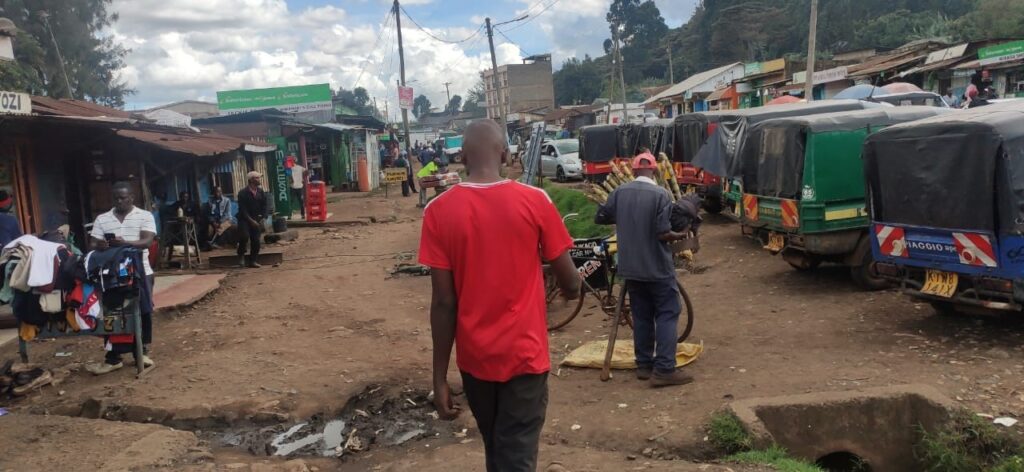
The first qualification was that only this small number accurately represented the passionate key stakeholders and leaders of sub-groups within the community, according to the wisdom of Mbede, P. (2025b). Further, according to Smith, these exceptional individuals were most likely willing to give their time and resources to help with the community’s transformational development. Therefore, Mbede suggests that it was vital to have a small team of principal individuals who would be liable for representing the community and transmitting information about the project to the community. Therefore, the picture in figure 1.1 shows Alex, one of the select leaders, going out into the community to recruit the people to come for the transformational community conversation. Who were these key players?
2.1.1 Profiling the Key Patrons of the Dagoretti Market
During the mapping stage, a few names emerged to constitute the project’s steering committee. However, as we met to plan for the project, another name had to be added to the team to make it more diverse and inclusive. Who were these people, and what did they signal for the project?
2.1.1.1 Meeting the New Patrons of the Dagoretti Market
- Anne, the Owner and Operator of Purefresh Water Dispenser ~ She became the project’s Patron
- Alex, the Transport Manager within the Dagoretti Market Stage ~ He became the project’s Coordinator
- Njambi, the Operator of Betpalace ~ He became the project’s Treasurer
- Tony Njuguna, the Brilliant Mechanic ~ He became the project’s Secretary-General and Spokesman
- Sammy, the Motorcycle (Boda Boda) Rider ~ He became the project’s Light Transport Errand
- Njoroge ~ The New Entrant who became the project’s Evaluator and the Youth Representative
What goals and objectives did these key representatives have?
3. #2nd step of planning ~ Prioritizing and Delineating Objectives and Goals
A very animated discussion bordering on an argument took place within the wider community (before the smaller steering group was formed) during the mapping phase of the project. This is because the immediate burning bush at hand, called the bloodshed of the innocent, was still raw, and the stakes at hand for the speakers were not only personal but also mostly ancestral. Thus, as they spoke, they tended to be emotional, rushed, and oblivious to the magnitude of the giant in the room. Therefore, as we sought to guide them to realistically prioritize and delineate their community objectives and goals in the spirit of looking within rather than looking without for the solutions, we needed to help them stake the fence around the following key principles:
3.1. The Key Principles Guiding the Prioritization and Delineation of the Community’s Objectives and Goals
- Information Management: Though the public forum was an open forum where all could freely express themselves, the ultimate decision on what to incorporate, however, rested with the key steering committee from among them.
- Intentional Inclusivity: Though the sober adults among them tended to dominate the meeting because of conflicting loyalties, interpersonal conflicts, hidden agendas, and a clash of interests, careful attempts were, however, made to ensure that the final steering committee was inclusive of the wider community demography.
- The Empowerment of the Team: Though the team consisted of the best crop from the community, they still needed great empowerment to function correctly as a team and help realize the corporate transformation of the community. The community, therefore, is committed to fully empowering them for their good.
- Active Participation: Though the select team was the community’s spearhead, the wider community, through their active participation in tandem with them, was the real thrust of the javelin. Therefore, the wider community had to remain active in the project throughout since, without them, the team had no power to steer them forward. Smith further reveals that their participation allowed them to understand why things were how they were while also giving them the confidence that they could exert some level of influence over what happens to them.
- Identifying the Opportunity Cost: Though the community had many needs, they had to be guided to start with a need they have chosen, but one that is relatively easy to solve. This was critical because success breeds motivation, while failure would discourage them if they began with larger, unattainable projects. Further, they needed to have the capacity to implement and maintain the project; hence, they had to choose a realistic project that would use as many local resources as possible. This is why, instead of going full nuclear on alcoholism, they opted instead to focus on realistic sensitization that was doable, fun, and directly fulfilling to the participants. After this sobering deliberative process, how did they arrive at the clear “winner”?
4. #3rd step of planning ~ Delineating Specific Objectives and Goals
Though the majority of the community readily agreed that the most significant problem facing the community was alcoholism, the challenge soon emerged, namely, how to eradicate it. Thus, clip 1.1 in the addendum, partly where Alex, the transport manager, is ranting, reveals the barney that took place as each community member actively and openly shared their thoughts on what they felt should be the main key way the community resolved its problem of alcoholism. During this ‘selecting-the-winner-process’, emotions ran very high, and monologues continued forever, as the philosophers debated, the traditionalists pontificated, and the religious preached. At the same time, the intellectuals experimented with one thought to another. To crystallize what the community shared, the following main ideas were shared before, finally, the Wise Solomon among them judged on the surest opportunity cost. What were these highlights?
4.1. The Highlights of the Key Mutuini Ward Community Needs
- Njambi: She boldly reminded the community of an actual exciting event that had occurred in the past years as the local MCA Hon. Anthony Kiragu alias Hon. Mato led a staid team from the National Liquor Board to raid the premises stocking the kienyeji brews, i.e., the second generation alcoholic beverages. Though several stockers and suppliers of these poisonous suffered significant losses as their shops were violently raided and their illicit goods broken and set ablaze, they had eventually managed to bribe their way out of the mess once the zealous officers were gone and were now back to business with a bang! As a result, the vicious cycle continued!
- Sammy: Recounting what he had earlier narrated to us, he plied the people with the unfortunate tale of how the broken community had matched up to the local administration in the wake of the merciless murder by the gang. He implored the community to do another significant protest once again. Unfortunately, before he could finish his Vox Populi, Vox Dei sermonette, he was violently drowned down with bitter reminders of how corrupt the same establishment they hoped to petition was! With this, the populist preacher took up his seat in defeat! What to do? It was time for gentle guidance for the community to defer to a select team to decide what exactly it was that they wanted to accomplish amidst all the competing options by simply setting goals and objectives.
4.2 Helping the Community to Set Goals and Objectives
To help them set goals and objectives, we needed to professionally define the difference between the two before allowing them to arrive at a natural outline of the same. What, then, did the community learn and agree to?
4.2.1 Defining the Community’s Goals ~ Eradication of Alcoholism in Mutuini Ward
Defining goals helped the community realize that these were generally broad statements about what they ultimately hoped to accomplish. It was that long-term change that they hoped to see, which, in this case, was the eradication of alcoholism in their beloved community. How was this ideal to be broken down into simple, manageable steps? The people needed to be tutored on the next aspect of planning, namely, understanding objectives.
4.2.2 Defining the Community’s Objectives ~ Social Mobilization Against Alcoholism in Mutuini Ward
As the attentive community listened, we cheerfully explained to them that the objectives were the specific, immediate steps that were to be taken to achieve the stated goal. As a process aimed at raising awareness and motivating those impacted by a problem to compel them to claim change, social mobilization against alcoholism, as explained by Muga, W. (2015), was then the surest objective to be pursued by the community. This is because it was going to incorporate diverse but effective elements of transformational change championed by Muga, such as advocacy and awareness, social marketing, behavioural change communication, and capacity strengthening. Therefore, the community was made to understand that this social mobilization objective was a practical approach because it was a clinically accurate antidote in tackling the myriad risk factors around alcoholism, such as idleness, work-related stress, peer pressure, unemployment, and family issues, which primarily affect women within the community. Therefore, after the community clearly understood the social mobilization approach as the surest remedy for addressing the myriad risk factors that they faced and the surest psychosocial force for reversing alcoholism’s impact within their community, their buy-in into the vision was complete. Furthermore, to make it more straightforward, we explained to them that the social mobilization objective that they had unanimously chosen was good because, in addition to being effective, it also comprised five characteristics that form the acrostic SMART, i.e.:
S – Specific, i.e. it was precise in defining the approach to be taken by the community,
M – Measurable, i.e. it was quantifiable as a means to an end,
A – Attainable or Achievable, i.e. it was a doable activity within the community’s priorities,
R – Relevant or realistic, i.e. it was a genuine ideal within the community’s reach, and most importantly,
T – Time-bound. It had a beginning and an end, i.e. it would not be a forever-cyclic activity. Feeling greatly enlightened, the buoyant community was ready to act out the plan!
5. #4th step of planning ~ Action Plan
Having understood the magic objective of eradicating alcoholism from their community, the Mutuini residents and their leaders were eager to know the step-by-step activities needed to accomplish the already-stated goals and objectives.
5.1. Helping the Community to Understand the Characteristics of a Good Action Plan
Rising to the sacred moment in the wisdom of Mbede, we described to them what would happen to whom, where it would happen, when, and who would be in charge. Notably, we assured them that the action plan would be good since each step would have a completion date. Further, as the roadmap to achieving the development project chosen, the action plan was detailed since the wisdom of Smith dictated that the more detailed the action plan, the more effective and helpful it would be. However, the community had to be reminded that although the core team they had chosen was responsible for creating the action plan, the community and the team needed to be involved in the actual project work. Therefore, being a team member did not mean that one did not have to work; it only meant that one was also responsible for the strategy and organization of the project. This is because Mbede wisely warns that the best leaders (and team members are leaders) lead in every way, even when it means getting dirty and sweaty! What was the action plan that the team came up with after a back-and-forth of about two weeks, primarily conducted via the phone amid their busy schedules?
5.2. The Summary of the Action Plan
The following table summarizes what the team came up with after much deliberation.

5.3. Reviewing the Action Plan
After writing up the action plan, the group met online and asked themselves the following questions:
- The Spirituality of the Plan: Had spiritual steps been integrated into the plan? The firm answer was in the affirmative.
- The Gelling of the Church and Community Members of the Plan: Was the workload evenly distributed among church and community members? The team agreed that some adjustments would be made in the project’s next phase.
- The Viability of the Plan: If the action plan steps are carried out, will the goals and objectives be met? The team agreed that though the plan looked watertight, some adjustments would need to be made in the project’s next phase that was to follow shortly.
6. Recommendations
With the ink of the planning committee still wet, there were a few observations worth making that helped the project advance without hiccups. Below is the highlight of what was observed and proposed to the team as they now prepared for the next phase:
1#proposal: Flexible Methods and Forms of Information Gathering ~ Since much of the work would involve heavy information gathering and dissemination, there would be a serious need to be flexible. This is because trends were bound to change, as were the people and the needs being reached.
2#proposal: Greater Openness to Continuous Learning ~ Since the social awareness approach to alcohol eradication was a novel approach in community transformation, there was a serious need for the leading community team to be open to a culture of continuous learning to meet the demands of the call. This would demand a commitment to continuous, adaptable research and resource utilization.
7. Conclusion
After the exhaustive deliberation from this second phase of the project, it became very clear that this team did not come for games but were truly determined to truly transform their community. They were not only angry at their community’s dire situation but also vitally hungry to learn on the job to get the project ahead. Therefore, they kept learning, unlearning, and meeting during odd hours by any means necessary to push as much as they could to ensure the project’s success. Having conscientiously followed the four steps of planning namely building a robust team, prioritizing and delineating objectives and goals, delineating specific objectives and goals, and creating an action plan. With this, the next phase of the project was now calling for their presence without delay, and we couldn’t wait to watch the real action now unfold!
8. Recommendations
With the ink of the planning committee still wet, there were a few observations worth making that helped the project advance without hiccups. Below is the highlight of what was observed and proposed to the team as they now prepared for the next phase:
1#proposal: Flexible Methods and Forms of Information Gathering ~ Since much of the work would involve heavy information gathering and dissemination, there would be a serious need to be flexible. This is because trends were bound to change, as were the people and the needs being reached.
2#proposal: Greater Openness to Continuous Learning ~ Since the social awareness approach to alcohol eradication was a novel approach in community transformation, there was a serious need for the leading community team to be open to a culture of continuous learning to meet the demands of the call. This would demand a commitment to continuous, adaptable research and resource utilization.
9. Addendum
Clip 1.1: Alex Giving His View on the Action-Plan
Source: Author, March 2025
Figure 1.1: Alex Reaching out to the Community.jpeg

Source: Author, March 2025
Figure 1.2: Alex Heading to the Meeting Venue.jpeg
References:
Acemoglu, D., & Robinson, J. A. (2012). Why nations fail: The origins of power, prosperity, and poverty. Random House. Retrieved from Amazon.ca
Anyanzwa, B. (2021). A Dagoretti Story: Say No To Alcohol Addiction And Yes To Wellness. The National Assembly Lady Spouses Association of Kenya (NALSA-K). Retrieved on 4-15-2025 from https://nalsa.co.ke/a-dagoretti-story-say-no-to-alcohol-addiction-and-yes-to-wellness/
Carte, P. (2002). Bridging the culture gap: A practical guide to international business communication. Retrieved from Amazon.com.
ConstitutionNet. (n.a). Dagoretti Constituency. Retrieved on 4-15-2025 from https://constitutionnet.org/sites/default/files/DAGORETI%20CONSTITUENCY.pdf
Jane W. Kanina, J.W. (2014). Alcohol Consumption and Healthcare Expenditure in Kenya. Social Sector Division, Kenya Institute for Public Policy Research and Analysis. KIPPRA Discussion Paper No. 164. Retrieved on 4-15-2025 from https://repository.kippra.or.ke/server/api/core/bitstreams/bd4ede5d-0ebd-4646-96d6-805ea92dbf73/content
Kamau, H.W. (2015). Study Of Land Use And Management Practices In The Peri Urban Areas Of Kenya Case Of Mutuini Location, Nairobi County. A Thesis Submitted In Partial Fulfilment Of The Requirements For The Award Of The Degree Of Master Of Arts In Planning, University Of Nairobi. Retrieved on 4-15-2025 from https://erepository.uonbi.ac.ke/bitstream/handle/11295/90140/Kamau_Study%20of%20land%20use%20and%20management%20practices%20in%20the.pdf?sequence=1
Kenya National Bureau of Standards (KNBS). (2010). Kenya Demographic and Health Survey (KDHS) 2008-09. Nairobi: KNBS.
Kenya National Bureau of Statistics (KNBS). (2010). http://knbs.or.ke/Census%Results/KNBS%Brochure.pdf. Retrieved March 7, 2014, from http://knbs.or.ke: http://knbs.or.ke/Census%Results/KNBS%Brochure.pdf
Kenya National Highways Authority (KENHA) Nairobi Region. (2009). http://www.kenha.co.ke/downloads/other/nrb_region.pdf. Retrieved April 5, 2014, from http://www.kenha.co.ke: http://www.kenha.co.ke/downloads/other/nrb_region.pdf
Kenya Open Data. (2009). https://www.opendata.go.ke/Population/Dagoretti-Pop-Density-view/vqytin92. Retrieved April 5, 2014, from https://www.opendata.go.ke: https://www.opendata.go.ke/Population/Dagoretti-Pop-Density-view/vqyt-in92
Kenya, L. (2011). http://siteresources.worldbank.org/INTAFRICA/Resources/257994- 1335471959878/Urban_Areas_and_Cities_Act_2011.pdf. Retrieved July 1, 2014, from http://siteresources.worldbank.org:
Kenya, L. (2012c). http://siteresources.worldbank.org/INTAFRICA/Resources/257994- 1335471959878/the-intergovernmental-relations-act-2012.pdf. Retrieved July 1, 2014, from http://siteresources.worldbank.org: http://siteresources.worldbank.org/INTAFRICA/Resources/257994- 335471959878/theintergovernmental-relations-act-2012.pdf
Kenya, L. (2012g). http://faolex.fao.org/docs/pdf/ken112132.pdf. Retrieved July 1, 2014, from http://faolex.fao.org: http://faolex.fao.org/docs/pdf/ken112132.pdf
Kirambia, M. (2025, February 12). Dagoretti Traders Light Bonfires & Block Roads While Protesting Drug Influx. Retrieved on 4-15-2025 from https://www.kenyans.co.ke/news/108896-dagoretti-traders-light-bonfires-block-roads-while-protesting-drug-influx
Kiumi, J., Kibe, S., & Nganga, S. (2013). Influence of pupil-teacher ratio and school location on pupils’ performance in exit examination in Kenya’s Free Primary Education Program. International Journal of Economy, Management and Social Sciences , 2 (6), 423-431.
KNBS. (2019). Kenya Population and Housing Census: Volume IV Distribution Of Population By Socio-Economic Characteristics. Kenya National Bureau of Statistics. Retrieved on 4-15-2025 from https://www.knbs.or.ke/wp-content/uploads/2023/09/2019-Kenya-population-and-Housing-Census-Volume-4-Distribution-of-Population-by-Socio-Economic-Characteristics.pdf
Madinda, J. Y. (2019). The Theory and Practice in Mission and Development:Challenges and Pitfalls. Retrieved on 2-06-2024 from https://pacu.mrooms.net/course/view.php?id=4856#section-3
Mbede, P. (2025a). 4 TRANSFORMATIONAL_DEVELOPMENT_AND_THE_CHURCH_evangelism_and_witness_holistic_witness.pdf. Week 4 Lecture 4 Evangelism and Witness: Holistic witness. Retrieved on 2-19-2024 from https://pacu.mrooms.net/mod/folder/view.php?id=288029
Mbede, P. (2025b). 5 – TRANSFORMATIONAL_DEVELOPMENT_AND_THE_CHURCH.pdf. Week 5 Lecture 5 Development Process. Retrieved on 2-19-2024 from https://pacu.mrooms.net/mod/folder/view.php?id=288030&forceview=1
Muga, W. (August 7, 2015). Dealing With the Alcoholism Epidemic Through Social Mobilization. Research Assistant, African Population & Health Research Center, APHRC. Retrieved on 4-17-2025 from https://aphrc.org/blogarticle/dealing-with-the-alcoholism-epidemic-through-social-mobilization/#:~:text=The%20first%20step%20is%20to,victims%20should%20also%20be%20reached.
Mutillah, W. (2003). Street vending in African cities: A synthesis of empirical findings from Kenya, Cote D’Ivoire, Ghana, Zimbabwe, Uganda and South Africa. Washington DC: World Bank.
Mutuini Hope Centre. (April 2019). This Is Our Story: Mutuini Hope Centre. Retrieved on 4-15-2025 from https://www.globalgiving.org/pfil/51590/projdoc.pdf
Muturi, J.T. (2013). Compliance of Slaughterhouses to Environmental Regulations: a Case Study of Dagoretti Market Abattoirs, Kikuyu District, Kenya. Master Of Arts In Environmental Planning And Management In The Department Of Geography And Environmental Studies, University Of Nairobi. Retrieved on 4-15-2025 from https://erepository.uonbi.ac.ke/handle/11295/62780
Myers, B. (2019). Walking with the Poor: Principles and Practices of Transformational Development. Maryknoll, NY: Orbis Books. Retrieved on 2-06-2024 from https://pacu.mrooms.net/course/view.php?id=4856#section-3
Oyake, L., Njenga, B., & Koech, M. (2003). http://www.unep.org/geo/pdfs/NCEO_Report_FF_New_Text.pdf. Retrieved April 5, 2014, from http://www.unep.org: http://www.unep.org/geo/pdfs/NCEO_Report_FF_New_Text.pdf
ResearchGate GmbH. (2008-2025). Map of the study area indicating the wards of Dagoretti South Subcounty within Nairobi County (bottom) in Kenya (top). Retrieved on 4-15-2025 from https://www.researchgate.net/figure/Map-of-the-study-area-indicating-the-wards-of-Dagoretti-South-Subcounty-within-Nairobi_fig1_374123064
Smith, Miriam and Suzanne Hurst (2008). Transformational Development and
Thaiya, J.W. (2008). An assessment of the pollution of Kabuthi river by wastewater from Dagoretti slaughterhouses complex in Kiambu district of Kenya. Master in Veterinary Public Health, Department of Public Health, Pharmacology and Toxicology, Faculty of Agriculture & Veterinary Medicine (FAg / FVM) [3067]. Retrieved on 4-15-2025 from http://erepository.uonbi.ac.ke:8080/xmlui/handle/123456789/19157
The Church. Springfield: Africa’s Hope. (pdf). Retrieved on 2-06-2024 from https://pacu.mrooms.net/course/view.php?id=4856#section-3
Voice Of Dagoretti South – VODS. (2023a). Men from Dagoretti market alcohol and drugs. Retrieved on 4-15-2025 from https://www.facebook.com/groups/1660013397463475
Voice Of Dagoretti South – VODS. (2023b). Police know the drug lords of Dagoretti Market and their killer gangs; they know where to find them. Retrieved on 4-15-2025 from https://www.facebook.com/groups/1112008838860236/posts/9468911426503227/
Wafula, W.M., Wasonga, O.V. (October 2021). Analysis of Actors and Activities at Dagoretti, Livestock Market in Nairobi City, Kenya. International Grassland Congress. Department Of Land Resource Management & Agricultural Technology, University Of Nairobi. Retrieved on 4-15-2025 from https://larmat.uonbi.ac.ke/node/850