

Drinking From Science’s
Drinking From Science’s Abana And Psychology’s Pharpar Versus Washing In The Jordan ~ Curing Naaman By Comparing And Contrasting Christian Counseling With Secular Counseling



1. Introduction
Listed at an enviable number 14 on the list of 100 of 20th century’s most eminent psychologists by the American Psychological Association, William James, that peerless founder of the Psychology Department at Harvard University whose name still dot the main Psychology Department’s building, is a colossus that any dwarf will beg not to host in his living room. Yet, an unlettered but prayerful messenger of the Cross whose name is unknown and who knew no mighty alphabet save only those within the Holy Scriptures was astonished to receive him as he left the majesty of his Psychology palace in Massachusetts to be cured. As if taking a cue from the mighty Naaman of the 2 Kings 5:1-27 fame, William James bowed himself and was miraculously healed of his psychological disease through a simple prayer. Journeying back to those troubled zones of the Middle East, we meet the valiant national hero dearly beloved by the King called Naaman, who also had to abandon the Harvard of military valor to come and drench in the sluggish Jordan. Though he protested that his native Abana and Pharpa were superior to the dirty Jordan, Naaman finally heeded the counsel of his juniors and followed the one-liner to dip himself seven times in the Jordan and be cured. What does this show us? At a time when the Abana of Science and the Pharpar of Psychology continue to compete with the simplicity of the Cross found in the mouth of babes with Divine power, we have to go back to the intellectual Harvard and militarized Syria to realize that there is a slight similarity and significant differences between Christian Counselling and Secular Counselling. What are these similarities and contrasts? The following work highlights the comparisons and contrasts between Christian and Secular Counselling by reviewing the Naaman’s miraculous healing journey. How do we define Christian Counselling and Secular Counselling?
2. Defining Christian Counselling and Secular Counselling
2.1 Christian Counselling
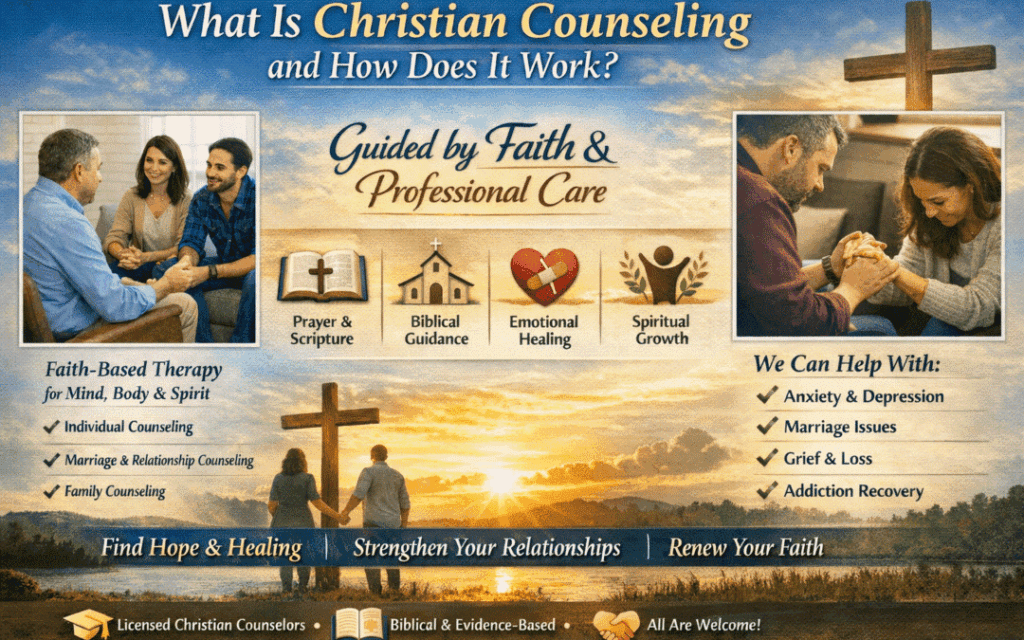
According to Riley, M. (2025), the Association of Christian Counselors defines Christian counseling as activities that “seek to help people towards constructive change and growth in any or every aspect of their lives, through a caring relationship and within agreed relational boundaries, carried out by a counselor who has a Christian worldview, values, and assumptions.” From here, we can derive the following as the emphasis of Christian Counselling: achieving personal development and realizing emotional healing by emphasizing spiritual principles, the sole belief in the Lord Jesus as the source of true healing, hope, and transformation. Again, we can deduce the following from the process: reliance on prayer and Biblical teachings to guarantee direction, comfort, and advice to their troubled clients.
What is Secular Counselling?
2.2 Secular Counselling
Non-religious counseling or secular therapy, on the other hand, can be defined as using evidence-based techniques and treatments to tackle mental health issues and any other related challenges using psychology, science, and research. Therefore, a secular counselor will attempt to work with the client to establish attainable goals and individual needs using psychological interventions and talk therapy. How does this approach compare to Christian Counseling?
3. Is Syria’s Abana and Pharpar, and Israel’s Jordan All Water? ~ Reviewing the Main Similarities between Christian Counseling and Secular Counseling
All water is just but water until a discerning man, who knows his real need, seeks a quench. Thus, in times of trouble, the needy souls will either turn to the world’s rivers (which Lukano, R. (2025b) calls civilization’s broken cisterns) or to God’s Divine River. In the case of William James, he first began with the intellectual rivers flowing freely through Cambridge streets in Massachusetts and in Europe’s leading cities. As for Naaman, he tried Abana and Pharpar before drenching in the Jordan. Thus, up to this point, two sets of water with similarities and dissimilarities will be a ready option for counseling. Why, again, do we use the analogy of a river, especially with these two sets?
At the core, we can easily deduce six significant similarities between Syria’s two main Rivers of Abana and Pharpa, and Israel’s River Jordan: origin, chemical composition, usage, label/name, national heritage, and seasons. Interestingly enough, we can also easily list six significant similarities between Christian Counselling and Secular Counselling. This means these two forms of Counseling share similarities in an almost similar fashion as the leading Rivers of these two different nations. What, then, are these hexatonic similarities?
3.1 #1st similarity ~ Probing of the Past ~ the rivers’ origin
Probing the source of Abana and Pharpa, Douglas, J., Tenney, M. and Silva, M. (2011) informs us that the modern River Barada travels majestically from Israel’s snow-capped Mount Hermon through Syria and ends up in a marsh. River Jordan’s source is also identifiable for Brand, C. et al. (2003), tell us that the main tributaries namely Bareighit Banias, Hasbani, and el-Leddan Rivers are from Mount Hermon’s foothills. Thus, we can argue that Naaman was not impolite in insisting that he dip himself in Abana and Pharpa, seeing that they all flowed from the same source, Mount Hermon, in the Holy Land. Thus, whether the therapist is Christian or not, they insist on the same ‘Mount Hermon’ called the past to try and probe the source of the flowing River of misery!
This means that in Christian and Secular counseling, counselors sometimes probe the client’s past to ascertain how it could impact the present. This is because sometimes the present issue could have its roots in the past, whether childhood or a recent event. Therefore, both share the same ‘Mount Hermon’ fascination as they probe why their client has come to their office. What, then, is in their water? Is the water essentially similar in composition?
3.2 #2nd similarity ~ The Use of Some Similar Therapeutic Techniques ~ the rivers’ chemical composition
At a chemical level, Syria’s two main Rivers of Abana and Pharpa, when compared to Israel’s River Jordan, are simply H2O, meaning they are mass-flowing water bodies and all emerging from the same Mount Hermon, as already shown. This means that in an attempt to tackle both the emotional and psychological health of their clients, counselors in both Christian Counseling and Secular Counseling have often used the same techniques of therapy.
The three therapy techniques are person-centered therapy, cognitive-behavioral therapy (CBT), and solution-focused therapy. They can easily be compared to the two atoms of Hydrogen and one atom of Oxygen that form the water of the two river sets of Syria and Israel. Why do these Rivers flow? What do the Rivers aim to achieve by their flow?
3.3 #3rd similarity ~ Shared Desire ~ the rivers’ usage
Douglas again informs us that the Greek rightly calls Abana and Pharpa the Chrysorrhoas or the “Golden Stream” because they divide into nine or ten branches in the East of Damascus, making the desert-bordering Damascus a fertile oasis and wonderfully beautiful to behold. On the other hand, Jordan is called the Aulon or the “descending or immersing” because it forms the fertile Jordan Valley, an essential breadbasket. This shows us that, at the core, these two Rivers seek to nourish the people’s souls by bringing bread to them. This, again, can justify why Naaman was ready to pursue his cure from his native Rivers.
Therefore, looking at the motive of Christian Counseling and Secular Counseling, we see a shared desire to help their clients obtain bread for their souls in times of adversity. They share the desire to help them overcome their challenges, find joy and meaning in life, and become healthy and well-adjusted members of society, both emotionally and mentally. This bread-gaining general rule of shared desire, akin to using two river sets, is their other similarity. How, then, do the two River sets earn their label?
3.4 #4thsimilarity ~ Mandatory Training Obligation ~ the rivers’ label/name
As already seen, the Greeks label Syria’s main rivers Chrysorrhoas and Jordan, the Aulon, because of the consistent bread delivery to their natives. Therefore, by consistently surviving seasons of relevance, these Rivers have come to prove their mettle as sure water sources. It’s like these Rivers have undergone difficult training and proved themselves as competent. No wonder Naaman had a problem when the Prophet insisted on Jordan, seeing that his native Rivers were equally demonstrated in the record.
In the same way, most counselors in both Christian Counseling and Secular Counseling are trained professionals who have undergone training to gain competency within their fields. After rigorous seasons of tests and trials, these professionals have acquired sufficient theories and counseling techniques from their Rivers to help them undertake their duties. Notably, Christian counseling professionals integrate psychological and Biblical views into their practice in addition to their theological background. How do the Rivers view their natives? Do they despise or value them?
3.5 #5th similarity ~ Emphasis on Relationships ~ the rivers’ national heritage
When you journey through Judaism and Christendom, you often hear sermons and songs about the River Jordan. In the same way, Naaman was able to offer an on-the-spot pontification about his native Rivers because of the tremendous patriotic acclaim that they held. This means that the people on both sides have a special relationship with the Rivers, deeply identify with them, and even welcome all willing to give their Rivers a shot.
When helping their clients, both the Counsellors in Christian Counseling and Secular Counseling invite them to their River to share the same ideal of healthy relationships. This is because they both tend to believe that strong, healthy relationships are the key to good overall well-being and encourage their clients to improve their interpersonal dynamics, communication styles, and boundaries. Thus, both invite their clients to swim in the same River of healthy relationships to quicken their healing journey. What standards do they hold at all times when doing this?
3.6 #6th similarity ~ Insistence on Ethical Standards ~ the rivers’ seasons
Originating from the same Mount Hermon, the Rivers tended to enjoy the same ebb and swell that comes with the year’s seasons. Thus, the same lows and highs defined all the Syrian and Israelite Rivers. This is why Naaman was sure that if he was expected to dip in the River at any moment’s notice, his native Rivers could afford him the same volume, current, and result as Israel’s Jordan.
This standardization means that professional ethics are taken very seriously in Christian and Secular counseling forms; hence, ethical standards are critical to both. Thus, ethical standards like informed consent, confidentiality, and professionalism are significantly regarded in both fields since they undergird the welfare of the clients. However, despite these professional standards and codes, is Naaman correct in dismissing God’s Divine Jordan because of the hexatonic similarities already shown? Is Syria’s Abana and Pharpa ever comparable to God’s Jordan? Has any Prophet ever instructed another General to dip in these clean Syrian rivers, although they all stream from Hermon? Did we hear Jesus being baptized or His early Apostles baptizing in them? Have they ever cured leprosy or ceremonially washed away any sin? We now turn to the second part to show the stark contrasts between Syria’s two Rivers and Israel’s Jordan to prove the differences between Christian and Secular Counseling.
Is Science’s Abana and Psychology’s Pharpa Really Similar to God’s Divine Jordan? ~ Revealing the Main Contrasts between Christian Counseling and Secular Counseling
Writing sarcastically about the fruitless journeys William James had to make at the peak of his greatness while at Harvard to cure his nervous disorder and depression, Ravenhill, L. (2004) talks about how the great doctor first dashed to Europe, but Berlin had no answer. Knocking on the doors of Vienna, the Abana of Science was silent. Turning to the houses of Paris, the Pharpar of their Psychology sheltered no cure whatsoever. As the eminent therapist grew desperate, he dashed to nearby London, but his call only became an echo. As a measure of last resort, he rode cheerfully to the eminent sons of Scotland whose fame was revered, but there was no balm to be found in this Gilead. Heading back to America with suicide holding a concert in his large brain, the merciful Hill of Calvary eventually whispered a silent call. In a dramatic twist similar to that of Naaman, an uncultured man with the anointing treated the doctor and glorified God. Herein, in these twists, we begin to see the first differences between these two forms of counseling. What is the first?
4.1 #1st contrast ~ The Desired Result
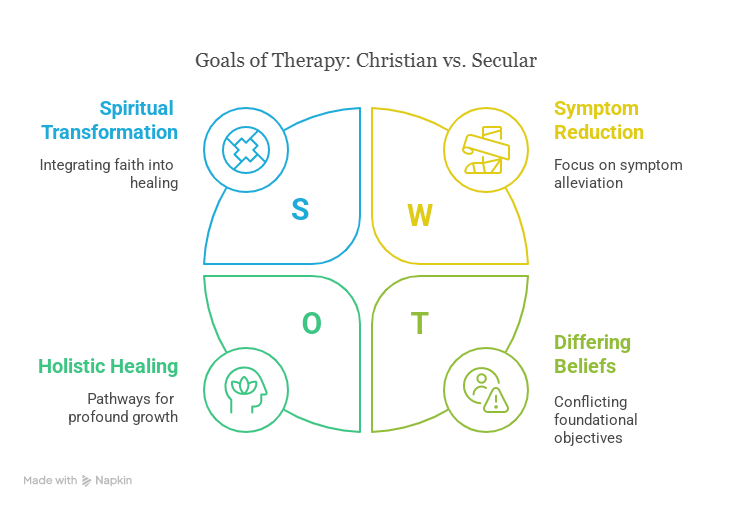
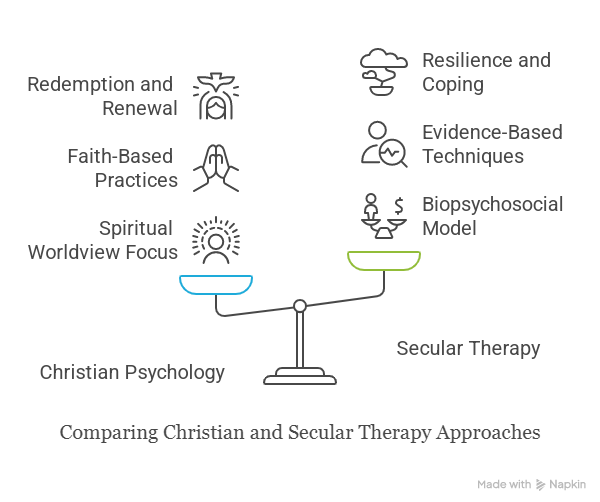
Before William met the humble man of God, he had been searching for temporal relief from his anguish. He wanted relief but not the transformation of his heart. Naaman also reported to Israel looking for a physical cure for his skin but not salvation for his soul since he was still an idolater who bowed to the Syrian God Rimon. Thus, their seeking was earthly and temporal, and their previous inefficient helpers were scientific but not spiritual. Therefore, the desired result is a primary difference between the two. This is because secular counseling focuses on increasing the client’s ability to function more effectively or to be emotionally stable to guarantee the desired result. In contrast, Christian counseling focuses on enabling the client to heal, interact more effectively with God, and eventually become a blessing to the Body of Christ with their gift. Who then did William and Naaman turn to?
4.2 #2nd contrast ~ The Key Agent of the Desired Change
As William and Naaman traveled for help, they first met and wrestled with one key person, namely themselves. As an eminent psychologist and philosopher, William wrestled for months as he sought to take charge of his troubled soul with the fleshly abilities of his mind. Back in Syria, we see Naaman wielding a national sword of valor as a decorated General, silently wishing that his conquering sword’s edge would slash his leprosy. Thus, William’s keen intellect and Naaman’s great national image tried but never delivered the results. They took charge, but their arms of the flesh could not reverse the curse!
This shows us that the agency of the desired changes within the client is another point of departure. This is because secular counseling sees the client as a self-empowered entity who must directly take sole charge of their desired changes. Christian therapy, on the other hand, allows the Person of the Holy Spirit to work through the therapist and within the client to facilitate the changes. In the case of William, Ravenhill writes that after hands were laid upon him, he felt a mysterious power rushing through his entire body, followed by a deep sense of peace that assured him that he was healed. Naaman’s skin became as clean and soft as that of a newborn child after the sevenfold dip into the Jordan. Thus, the resultant changes through this spiritual encounter are often more pervasive and deeply foundational. Consequently, the resulting modifications promote the client’s walk with God and his fellow man. What did the humble man use to cure William, and what did the Prophet use to cure Naaman?
4.3 #3rd contrast ~ Professional Tools and Craftsmanship
Another point of departure is the professional tools and craftsmanship of the two professions. This is because other forms of counseling heavily rely on scientific means, often devoid of spiritual elements. These scientific means include dialectical behavior therapy (DBT), mindfulness techniques, cognitive-behavioral therapy (CBT), etc. On the contrary, besides using a select blend of psychological knowledge and the Bible, Christian counseling employs spiritual tools like prayer, meditation, spiritual disciplines, and the like. In William and Naaman’s case, simple instructions uttered in faith resulted in their miraculous healing. This was another point of departure between the two forms of counseling. What manual did William and Naaman’s human counselors use to discharge their great miracles?
4.4 #4th contrast ~ The Place of the Bible
The place of the Bible is another key difference between Christian counseling and Secular counseling. This is because, unlike other forms of counseling that merely rely on psychological knowledge and research, Christian counseling heavily derives its compass of man’s identity, the nature of his challenges, the source of his challenges, and the means of solving them from the inspired Word of God. Thus, Christian counseling focuses on recognizing man’s sinful nature and how this nature impacts his emotions, thinking, and behavior. Consequently, unlike his secular counterpart, the Christian counselor is committed to helping his client navigate the redemptive process of helping him connect deeply to God, who will help him function according to His original ideals.
On the contrary, secular counselors view man as a reasonable being who only needs to correct his thoughts and behavior to help him be happy or actualized. Now, though some of the theories, research, and insights of secular counselors can be helpful to a Christian counselor (when compatible with the Word of God), it should be remembered that they only provide fragmented pieces of the puzzle in areas that the Bible does not expressly address. These pieces do not usurp the Bible’s authority as the sole source of truth. Thus, unschooled in worldly letters but intensely cultivated in the Truths of the Bible, the unknown man of God miraculously healed William. Though formerly a humble farmer and not a soldier, Elisha healed Naaman by relying solely on the Torah’s little. The sacred Book was seemingly little in both cases, but the resultant power was immense, delivering undisputable results.
5. Conclusion
When William went back to the Psychology Department bearing his name at Harvard after his miraculous healing from deep psychological affliction, he was still a lettered man mentally and professionally. Still, spiritually, he was a transformed man after his encounter with an anointed Christian Counselor who knew where the power socket was located. Naaman, too, returned to being a Syrian General, ceremonially bowing to god Rimon because of the complicated nature of his work. Still, he carried soil from Israel to construct a personal altar. He was outwardly Syrian but inwardly a spiritual Israelite. All these show us that there are significant comparisons and contrasts between Christian and Secular counseling. The key similarities are the shared desire, the mandatory training obligation, an emphasis on relationships, the use of similar therapeutic techniques, the insistence on ethical standards, and the probing of the past. The key points of departure are the desired result, the key agent of the desired change, the professional tools and craftsmanship, and most vitally, the place of the Bible. That is the experiential reality of drinking from Science’s Abana and Pychology’s Pharpa versus washing in the Jordan as we cure Naaman by comparing and contrasting Christian and Secular counseling.
References
Brand, C. et al. (2003). Holman Illustrated Bible Dictionary. [edition unavailable]. Holman Reference. Available at: https://www.perlego.com/book/2694039 (Accessed: 26 February 2025).
Collins, G. R. (2007). Christian Counseling: A Comprehensive Guide (3rd ed.). Thomas Nelson. [Kindle Edition]. Retrieved from Amazon.com.
Douglas, J., Tenney, M. and Silva, M. (2011). Zondervan Illustrated Bible Dictionary. [edition unavailable]. Zondervan. Available at: https://www.perlego.com/book/559070 (Accessed: 26 February 2025).
HOLY BIBLE (ESV)
Lukano, R. (2025a). Qualities of a Christian Counsellor SLIDES.pptx. Retrieved on 2-06-2025 from https://pacu.mrooms.net/course/view.php?id=4857#section-4
Lukano, R. (2025b). CHRISTIAN COUNSELING PPPT.pptx. Retrieved on 2-06-2025 from https://pacu.mrooms.net/course/view.php?id=4857#section-4
McMinn, M. R. (2011). Psychology, Theology, and Spirituality in Christian Counseling. Tyndale House. [Kindle Edition]. Retrieved from Amazon.com.
Mimosa Christian Counseling Center. (n.a). What is Christian Counseling versus Secular Counseling? Retrieved on 2-15-2025 from https://mimosachristiancounseling.org/what-is-christian-counseling-versus-secular-counseling/#:~:text=Another%20primary%20difference%20between%20secular,that%20is%20compatible%20with%20Scripture.
Narramore, B. (1979). The Psychology of Counseling. Zondervan. [Kindle Edition]. Retrieved from Amazon.com.
Powlison, D. (2010). Seeing with New Eyes: Counseling and the Human Condition through the Lens of Scripture. P&R Publishing. [Kindle Edition]. Retrieved from Amazon.com.
Psychology.fas.harvard. (2025). William James: Established Harvard’s Psychology Department. The President and Fellows of Harvard College. Retrieved on 26 February 2025 from https://psychology.fas.harvard.edu/people/william-james
Ravenhill, L. (2004). Why Revival Tarries. Bethany House Publishers. [Kindle Edition]. Retrieved from Amazon.ca
Riley, M. (2025). What Is Christian Counseling? SoulCare Counseling. Retrieved on 26 February 2025 from https://www.soulcarecounselingdfw.com/blog/what-is-christian-counseling#:~:text=The%20Association%20of%20Christian%20Counselors,who%20has%20a%20Christian%20worldview%2C
Tan, S. Y. (2011). Counseling and Psychotherapy: A Christian Perspective. Baker Academic. [Kindle Edition]. Retrieved from Amazon.com.
Tan, S.-Y. (2022). A Christian Approach to Counseling and Psychotherapy. [edition unavailable]. Cascade Books. Available at: https://www.perlego.com/book/3570592 (Accessed: 17 February 2025).